THE PROCESS FOR JOINING CHAPLAINCY SA
Joining Chaplaincy SA is the beginning of a structured journey of training, development, service, accountability, specialization, and continued growth. Our process is designed to ensure that every applicant understands the responsibilities of Chaplaincy and is properly prepared to serve individuals, families, First Responders, organizations, and communities with compassion, integrity, professionalism, and respect.
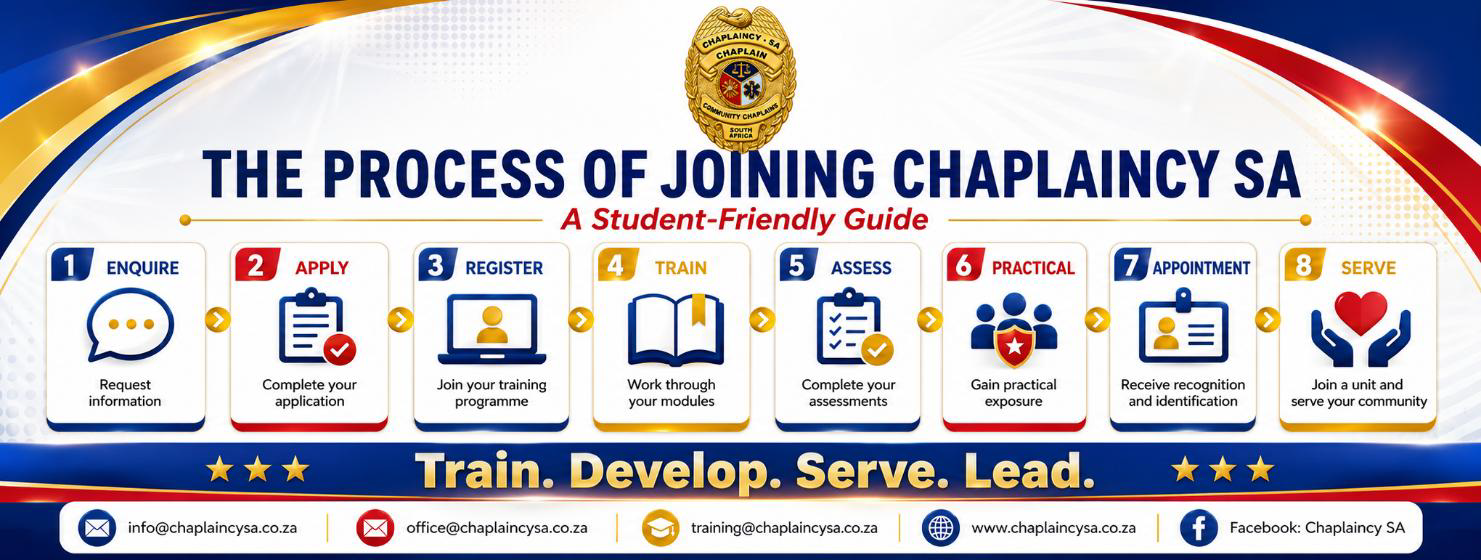
1. MAKE CONTACT WITH CHAPLAINCY SA
Your journey begins by contacting Chaplaincy SA and requesting information about becoming a Chaplain. Our team will guide you through the available training programs registration requirements, course options, fees, specialist areas, and the pathway most suitable for your interests and future service goals.
2. COMPLETE YOUR APPLICATION
Prospective members are required to complete the official Chaplaincy SA application and registration process. This provides the organization with the necessary information to assess your application, register you as a student, and begin your training and development journey.Applicants are expected to provide accurate information and comply with the administrative requirements applicable to their registration.
3. REGISTER FOR YOUR CHAPLAINCY TRAINING
Once your application has been processed, you will be registered for the appropriate Chaplaincy SA training program. Training may cover areas such as Chaplaincy, Pastoral Care, Counselling, Trauma Support, Psychological First Aid, Crisis Intervention, Community Support, Professional Ethics, Leadership, Theology, Grief and Bereavement, EMS Support, First Responder Support, Victim Support, and Professional Boundaries. Our training is designed to prepare students for real people, real communities, and real-life situations.
4. COMPLETE YOUR TRAINING MODULES
Students work through structured learning material covering the knowledge and practical principles required for effective Chaplaincy service. Training focuses strongly on compassionate communication, ethical conduct, confidentiality, professional boundaries, trauma-informed support, pastoral care, leadership, responsible referral, teamwork, community service, and understanding the limits of your role. The objective is not simply to complete material, but to understand how to apply it responsibly.
5. COMPLETE YOUR ASSESSMENTS
Students are required to complete the assessments applicable to their training program.Assessments are designed to measure understanding of the material and the student's ability to apply important principles safely, professionally, ethically, and responsibly. Successful completion of assessments forms an important part of progression through the Chaplaincy SA training pathway.
6. PRACTICAL DEVELOPMENT
Chaplaincy cannot be learned through theory alone.Students are encouraged to gain appropriate practical exposure through approved community, pastoral, outreach, hospital, care, support, or other service environments. Practical development helps students strengthen communication skills, confidence, discipline, teamwork, professionalism, and an understanding of how Chaplaincy functions in real-world environments.
7. SUCCESSFUL COMPLETION OF TRAINING
Once the required course work, assessments, and applicable practical requirements have been successfully completed, the student progresses toward formal recognition and appointment according to the relevant Chaplaincy SA program and organizational requirements. Successful completion demonstrates that the student has met the requirements applicable to that level of training.
8. APPOINTMENT WITHIN CHAPLAINCY SA
Approved candidates may proceed to formal appointment within the Chaplaincy SA structure. Depending on the level and role, members may receive appropriate appointment documentation, identification, certificates, insignia, uniform information, organizational guidelines, and operational instructions. Appointment carries responsibility. Members are expected to uphold the standards, policies, conduct, and values of Chaplaincy SA.
9. CHAPLAINCY IDENTIFICATION & UNIFORM
Where applicable, appointed members may receive or order the authorized Chaplaincy SA identification and uniform components relevant to their role. Uniform and identification represent responsibility, professionalism, and accountability and must therefore be worn and used in accordance with organizational rules and approved standards. A uniform does not create authority outside the member's actual role, training, or appointment.

10. JOIN A SPECIALIST CHAPLAINCY UNIT
Chaplaincy SA operates more than 70 Specialist Chaplaincy Units, allowing members to develop and serve within specialist fields that match their training, interests, experience, and abilities. Specialist areas may include Community Chaplaincy, EMS Support, Hospital Chaplaincy, Hospice Chaplaincy, Trauma Response, Victim Support, GBV Support, Child Protection Support, Correctional Chaplaincy, Disaster Support, First Responder Support, Counselling Support, Social Support, Community Outreach, Junior Rangers, and many other specialist areas. This gives members the opportunity to build a meaningful and focused service pathway.
11. BECOME ACTIVE IN YOUR COMMUNITY
Once trained and appointed, members are encouraged to become actively involved in appropriate Chaplaincy and community-service activities. Service may include community outreach, hospital visits, care-center support, First Responder support, pastoral care, family support, grief support, victim support, feeding programs, humanitarian outreach, community initiatives, and other approved areas of service. Chaplaincy SA believes that effective Chaplains should be visible, active, compassionate, responsible, and committed to the communities they serve.
12. WORK WITHIN PROFESSIONAL BOUNDARIES
Chaplaincy SA members must always understand the limits of their role. Chaplains do not replace Police Officers, Paramedics, Doctors, Psychologists, Social Workers, Attorneys, Investigators, or other regulated professionals. Members are expected to respect scene command, legislation, confidentiality, professional scope, operational procedures, safeguarding responsibilities, and the authority of relevant professional services. Knowing when to refer a person to another professional is an important part of responsible Chaplaincy.
13. CONTINUE YOUR DEVELOPMENT
Joining Chaplaincy SA is not the end of your training journey. With access to more than 3,000 different courses and training programs members have the opportunity to continue learning, specialize in new fields, strengthen leadership abilities, expand their knowledge, and develop throughout their Chaplaincy journey. Continuous development helps members remain informed, capable, professional, and prepared for changing community needs.
14. DEVELOP INTO LEADERSHIP
Members who demonstrate commitment, integrity, discipline, service, professionalism, and leadership potential may have opportunities to progress within the Chaplaincy SA structure.Leadership development may include officer training, command development, branch leadership, regional responsibilities, specialist-unit leadership, mentoring, and advanced professional development. Leadership within Chaplaincy SA is built on service and responsibility rather than title alone. Joining Chaplaincy SA means becoming part of a growing national network of people committed to care, service, leadership, community development, and compassionate support.
START YOUR JOURNEY TODAY
For information regarding applications, registration, training, courses, fees, membership, specialist units, and becoming a Chaplain, contact Chaplaincy SA: